
|
 |
 |
 |
 |
 |
 |
|
|
|
|
|
|
|
|



Yet, these "rules" don’t tell the whole story. A family making $200,000 per year can afford to spend 30 percent of its income on housing and have enough left over to meet other necessities, but a family making $20,000 might not be able to make ends meet on the income left over after spending 30 percent for housing. A family’s capacity to meet other expenses depends on other factors such as family size and age of children. To learn more about the difficult trade-offs that families face when housing is unaffordable, see the Center for Housing Policy's report, Something's Gotta Give [PDF]. |  Gates of Ballston, Arlington VA -- photo courtesy of AHC Inc. |
 Photo courtesy of McCormack Baron Salazar | Because there are many more eligible families than resources available to serve them, two other factors come into play in selecting families for admission to federally subsidized housing. The first is "income targeting" – a rule that directs a certain percentage of new admissions to families with incomes below 30 percent of the area median income. This rule is intended to ensure that families with the most severe housing needs are prioritized for scarce rental subsidies. The second factor is local admissions criteria which allows public housing agencies and private owners of assisted housing to admit families based on other criteria (e.g., priority to homeless families, the elderly, or selection by lottery). Click here to leave this site and access a chart providing more detailed |
So why do housing affordability problems persist in many communities? There are a variety of reasons, including that housing affordability is determined by the relationship between a variety of factors including income, rent or mortgage payments, and energy costs. Working families have seen only modest wage increases in recent years. In fact, after accounting for inflation, many families' incomes either remained flat or dropped while home values in many cities increased to unprecedented levels, even doubling in some metropolitan areas. Although prices have recently begun to decline, they haven't declined enough to be affordable to many working families. With stagnant wages, the only housing option for many working families has been rental housing. And the Center for Housing Policy has demonstrated through their Paycheck to Paycheck research that in most markets, even rental housing is out of reach for families that depend upon workers in low-paying jobs. These families require ongoing subsidies such as those provided by the federal government through its various rental assistance programs. Unfortunately, available subsidies serve only about one-quarter of those in need -- a strong argument for continued and expanded federal funding for these programs. | Photo courtesy of Potterhill Homes |
Others may have an ample supply of affordable homes but need to revitalize them to stimulate economic opportunity in some neighborhoods or preserve their endangered stock of affordable rental apartments. Whatever the circumstances, preparation of a comprehensive housing strategy helps avoid a haphazard approach to implementation of solutions and enables communities to address the housing needs of residents and members of the local workforce in an effective and coordinated fashion. Elements of an effective housing strategy include: (1) a needs assessment highlighting deficits in the local housing supply and resources available to address | _Residents_(2)_230x153.JPG) Photo courtesy of McCormack Baron Salazar |
_239x360.jpg) Crawford Square, Pittsburgh PA -- photo courtesy of McCormack Baron Salazar | The Rural Housing Service (RHS),
an agency in the U.S. Department of Agriculture, operates a broad range
of programs to support affordable housing and community development in
rural areas. RHS offers both direct loans and guarantees for mortgages
extended by others. Under the Section 502 program, loans help
low-income families purchase or rehab homes. The agency also operates
the Section 515 program which provides low-cost mortgages for property
owners to develop rental housing that is affordable to the lowest
income rural residents. Generate state or local funds. In addition to federal funds, many states and localities fund housing and community development from local revenue sources such as property taxes or general city or state tax revenue -- all of which have been affected by the economic downturn. Some communities earmark money from real estate transfer taxes to finance housing trust funds that, in turn, finance the construction or rehabilitation of homes. Some float general obligation bonds or use future tax revenues (tax-increment financing) to fund new housing efforts. Others levy impact fees on new developments as a way of funding some of the required infrastructure for new developments, including linkage fees on new commercial development. Click here to leave this section and learn more about generating additional capital for affordable homes. Mobilize non-traditional partners. Faced with shrinking budgets, some communities are leveraging support for affordable homes in other ways. For |
| Strategies to deal with these problems will differ from place to place, but much can be done to address these problems. Resources available nationwide, such as Low Income Housing Tax Credits and financing programs of the Federal Home Bank system, as well as state allocations of funding through the Community Development Block Grant and HOME programs, can be used to create more affordable homes in rural areas. The Rural Housing Service (RHS), an agency in the U.S. Department of Agriculture, operates the Section 515 program which provides low-cost mortgages for property owners to develop rental housing for the lowest income rural Americans. The agency also administers the Section 502 loan program to help low-income families purchase, build, repair, or renovate homes. Funds also may be used to refinance debts when necessary to help families avoid losing a home. | 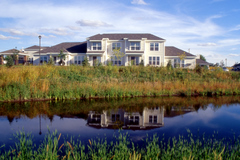 Country Lane, Lakeville MN -- photo courtesy of LHB Inc. |
CityHomes on Park, Minneapolis MN --photo courtesy of LHB Inc. | State governments play an important role in housing, too. They help lower the cost of homeownership through mortgage revenue bond programs and also can allocate their portions of CDBG and HOME funding, along with state matching funds, to areas throughout the state. Low Income Housing Tax Credits (LIHTCs), a major source of funding for new and rehabbed rental homes, also are allocated at the state level. Some states promote housing and community development through state-run housing trust funds or other funding mechanisms. In addition, states are responsible for allocating a large portion of Neighborhood Stabilization Program funds to their localities and guiding these localities in developing plans for using these funds to create and preserve affordable housing and stabilize communities wracked by foreclosures. |
Nonprofit organizations have been the sponsors, developers and operators of housing – particularly for low- and moderate-income people – for many years. Some nonprofit community development groups focus on the overall improvement of targeted neighborhoods. Others have as their mission serving vulnerable populations such as the homeless or physically and mentally disabled. Still others are sophisticated housing developers who specialize in putting together multiple funding sources to expand the supply of affordable homes. Housing often is utilized by nonprofits as a platform to provide supportive services such as job training, health care, child care, or transportation. Generally, most nonprofits are committed to making the housing they provide permanently affordable. This means they will be unlikely to opt out of affordable housing programs when market prices rise.
Nonprofits also have the flexibility to participate in unique partnerships. For example, some nonprofits provide housing counseling to the employees of private sector firms that offer employer-assisted housing benefits to their workers. Other nonprofits build close connections with residents of particular neighborhoods, gaining the trust of local residents that may be essential for the success of revitalization efforts. Nonprofits also can work with state and local governments to pool financing for specific housing developments. Or, they can advocate for broader policy changes, such as zoning changes that create more affordable housing opportunities in the communities they serve.
Hunter's Park, Arlington VA -- photo courtesy of AHC Inc. | That said, some research suggests the effects on surrounding property values may depend on the context, concentration and scale of the affordable homes. One review of the research literature found that affordable housing has no adverse effects and may even have positive impacts on property values when well-dispersed. When highly concentrated, however, there may in some cases be more negative impacts on property values, especially in neighborhoods that already are facing other challenges. [5] This suggests the importance of carefully developed affordable housing strategies that ensure that concentrations of poverty are avoided and that affordable homes are well-designed and constructed to ensure they are strong community assets. |
 Copyright © 2015 Center for Housing Policy. All Rights Reserved
|

